Hot water
Water heater repair and replacement
Water heaters in Huntersville homes sit in garages, attics, closets and crawl spaces. Where yours is matters as much as how old it is, because a tank that lets go in an attic does far more damage than one on a garage floor.
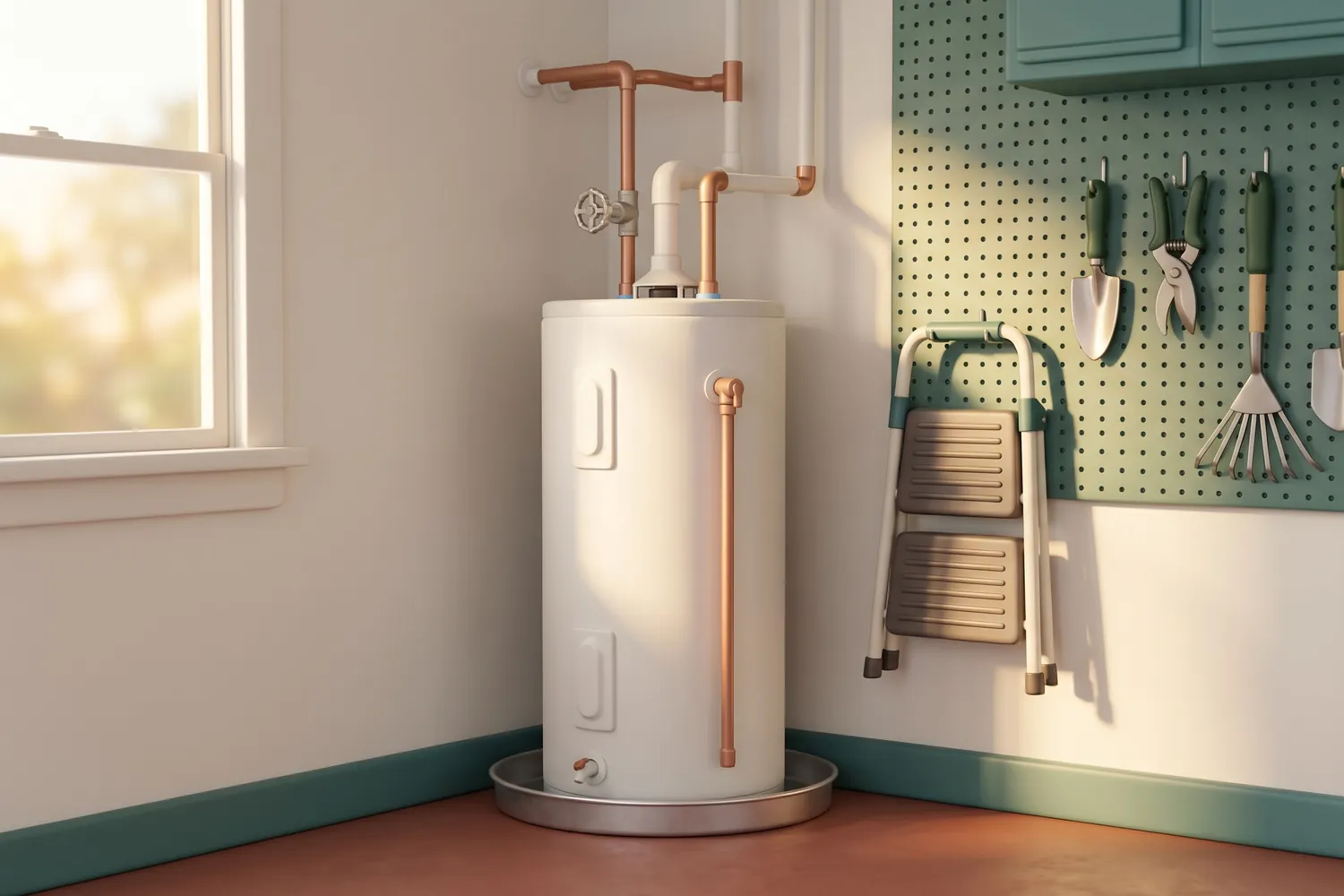
If the tank is leaking now
Do this first
- Close the cold-water valve on the pipe going into the top of the tank (number 1 on the drawing below).
- Electric tank: switch off its breaker. Gas tank: turn the control knob to off or pilot.
- Put a pan or towels under the drip and move boxes away from it.
- If water is coming from the small pipe on the side, not the tank itself, read the relief valve note below before you call it a leak.
Know the parts
What's inside a tank heater
Most repairs and most failures involve one of these seven parts. Use the numbers when you describe the problem.
- Cold-water shut-off. Turning this off stops water going into the tank. Do it first if the tank is leaking.
- Dip tube. Carries cold water to the bottom of the tank so the hot water stays on top.
- Anode rod. A metal rod that corrodes so the tank lining doesn't. When it is used up, rust starts on the tank itself.
- Temperature and pressure relief valve. Opens if the tank gets too hot or the pressure climbs too high.
- Discharge pipe. Carries water from the relief valve down toward the floor. Water dripping here is a warning, not a leak to plug.
- Drain valve. Used to flush sediment and to empty the tank before it is taken out.
- Heat source. A gas burner under the tank, or two electric elements inside it.
What it's doing, and what it usually means
No hot water at all
Electric: a tripped breaker, a failed element or thermostat. Gas: the pilot or igniter, or the gas valve.
Right now: Check the breaker once. If it trips again, leave it off.
Repair or replace?Hot water runs out quickly
Sediment has filled the bottom of the tank, the dip tube has broken, or one of two electric elements has failed.
Right now: Note how long a shower lasts before it cools.
Repair or replace?Rumbling or popping when it heats
Water trapped under a layer of sediment boils against the bottom. The tank is working harder and wearing faster.
Right now: Nothing urgent. Ask about flushing.
Keeping it goingRusty hot water only
The anode rod is used up and the tank lining is starting to corrode, or a steel fitting is rusting.
Right now: Run the cold tap. If cold is clear, it's the heater.
Repair or replace?Water dripping from the side pipe
The relief valve is letting water out because of high temperature or pressure, or the valve itself is worn.
Right now: Never cap or plug that pipe.
The relief valveWater under the tank
A fitting on top dripping down the side, the drain valve, or the tank itself. A tank that leaks through its wall can't be fixed.
Right now: Dry it and watch where it reappears.
Repair or replace?
The side pipe
The relief valve is doing its job
The temperature and pressure relief valve (number 4) opens when the tank gets too hot or the pressure in it climbs. Water from the discharge pipe (number 5) is a warning that something upstream needs attention: a thermostat set too high, a pressure reducing valve that has failed, or a closed plumbing system with no room for water to expand as it heats.
A plumber will check the house pressure with a gauge on a hose bib and may suggest an expansion tank. Replacing the valve alone doesn't solve the cause.
Repair or replace?
When fixing it still makes sense
Usually worth repairing
- Electric element or thermostat failure
- Gas igniter, thermocouple or control valve
- A leaking drain valve or a fitting on top
- A worn relief valve, once the cause is found
- Anode rod replacement on a tank that is otherwise sound
Usually time to replace
- Water seeping from the tank wall or the bottom seam
- Rust in the hot water with a new anode not helping
- Repeated repairs on an older tank
- You need more hot water than it can give
- The heater sits where a leak would ruin a ceiling and you want a different setup
Choosing a replacement
Tank or tankless
The plumbing company will look at your gas supply, wiring, venting and space before it suggests either. These are the questions that decide it.
Like for like
Swapping a tank for the same fuel and roughly the same size is the simplest job. The pipes, vent and wiring are already in place.
Tankless gas
Heats water as it flows, so it doesn't run out, but it needs a larger gas supply and its own venting. Moving from a tank often means new gas pipe and a new vent route.
Tankless electric
Draws a lot of power at once. Many houses need an electrical upgrade before one can be fitted. Ask the company to confirm with an electrician first.
Heat pump tank
An electric tank that pulls heat from the air around it. It needs room and air around it, so a small closet may not work. A garage often does.
Size
Count bathrooms and people, and think about the big tub or the teenager's shower. A larger tank costs more to keep hot; a smaller one runs out.
Location
Attic and upstairs closet heaters need a drain pan with a drain pipe. If yours lacks one, ask whether the new one will have it.
On the day
How a replacement usually goes
Water and power off
The plumber shuts the cold supply, turns off gas or power, and drains the old tank through the drain valve, often to a floor drain or outside with a hose.
Old tank out
Tanks are heavy even when empty. An attic heater may need two people and protection on the stairs and ceiling.
New tank in
Connected to the hot and cold pipes, with new flexible connectors, a new relief valve and discharge pipe, and a pan where one is required.
Gas and vent checked
On a gas heater the vent connection and the gas fittings are tested before the burner is lit.
Filled before heating
The tank is filled with a hot tap open so the air comes out. Turning the power on to an empty electric tank burns out the elements.
Permit and inspection
In Mecklenburg County, electric water heater change-outs go through the county's trade permit system, with the plumbing contractor as the main permit holder. Ask whether the permit will be pulled and when the inspection is.
Keeping it going
Small habits that add years
Have the tank flushed to clear sediment. In a tank that has never been flushed, a plumber may advise against starting, because loose scale can stop the drain valve from sealing again.
Ask about the anode rod when the heater is a few years old. It is the part that wears out so the tank doesn't.
Keep the area around a gas heater clear. Paint cans, gasoline and laundry piled against it are a fire risk and block the air it needs to burn properly.
Water heater questions
Is it safe to keep using a tank that drips from the relief pipe?
The valve is protecting the tank, so leave it alone and don't plug the pipe. Lower the thermostat and call a plumber to find out why it is opening.
Can a plumber replace a gas tank with an electric one?
Often, if the panel has room for the circuit. The gas line is capped and the vent is dealt with. An electrician may need to run the circuit.
Do I need to be home for the inspection?
Someone has to let the inspector in. Ask the company how the visit is booked and who will be there.
Why does the new heater take so long to give hot water at the far bathroom?
That is the cold water sitting in the pipe, not the heater. A recirculation pump is the usual answer for long runs.
Tank off, area clear?
Say what you see, where in the house it is and when it started. The plumbing company on the phone will tell you whether they handle that job and when they could come.
Talk to a local plumber
For leaks, clogs, water heaters, toilets, sewer and water lines in and around Huntersville.
Call (704) 555-0133Calls may be recorded. See how this service is paid and the privacy policy.